Sunday, September 28, 2014

On the Edge of the Dark Sea of Darkness

by Andrew Peterson
284 pages / 2008

My wife hasn't read this book, but she enjoyed it too. As I made my way through I couldn't help but read whole chapters to her, or, if she wasn't nearby, the next time she came by I'd update her about the all the wackiest bits. And there are a lot of wacky bits.

The "Dark Sea of Darkness" in the title gives a clue right off as to Peterson's goofy sense of humor. The subtitle is even better: "Adventure. Peril. Lost Jewels. And the fearsome toothy cows of Skree."

While I read the first three chapters to my wife (I just couldn't help it) I'll restrain myself here, and pass along only the first few lines of the opening which is titled: "A Brief Introduction to the World of Aerwiar." Peterson wants us to know this takes place on an entirely made up world so he begins with his own creation story:
The old stories tell that when the first person work up on the first morning in the world where this tale takes place, he yawned, stretched, and said to the first thing he saw, "Well, here we are." The man's name was Dwayne, and the first thing he saw was a rock. Next to the rock, though, was a woman named Gladys, who he would learn to get along with very well. In the many ages that followed, that first sentence was taught to children and their children's children and their children's parents' cousins and so on until, quite by accident, all speaking creatures referred to the world around them as Aerwiar
That gives a good taste of the fun that is to follow.

The heroes of this epic tale are three siblings: Janner and his little brother Tink, and their littler sister Leeli. The villains are the Fangs of Dang, under the direction of the "nameless evil...whose name was Gnag the Nameless." Our story begins nine years after the Fangs sailed across the Dark Sea of Darkness and conquered the lands of Skree, and it is in a little cottage, in this conquered land, that the family Igiby resides: the three children, their mother, and their grandfather.

The Fangs are cruel, bureaucratic, and they look exactly like "...humans except for the greenish scales that covered their bodies and the lizard-like snout and the two long venomous fangs that jutted downward from their snarling mouths." Oh, and they have tails. And worst of all, they think the Igbiy's have the lost Jewels of Anniera!

Janner, Tink and Leeli don't know anything about any jewels, but they're curious sorts, and they are eager to find out all they can. So Peterson is writing not just a fantasy, but also a mystery, and certainly a comedy. And he's managed to slip in a really good chase film too.

Caution

A word of warning might be due as far as the comedy is concerned. Some of it could be described as juvenile: no potty humor, but Janner does, at one point, discover a candle made of "snot wax." Peterson peppers the book with footnotes and for the candle he has this entry:
1. Snot wax is too repulsive a thing about which to write a proper footnote.
Then there are the vile Fangs of Dang. Their name gives a good indicator of the line that Peterson draws: it leaves no doubt that they are a vile bunch, but Peterson isn't going to use vile language. And yes, the Fangs like to eat brown lettuce, maggot-loaves and anything that wriggles, but this humor is all of sort that will appeal to boys, gross out their sisters, and leave parents largely untroubled.

Conclusion

But what mom and dad are sure to love is the prominent place that parents have in Peterson's story. In most teen fiction parents are either dead or dumb; the teen hero is either an orphan or wishes he was.

Here we have a well-respected mother and a grandpa who is doing what he can to fill in for the sibling's long-dead father. So when Janner makes a big mistake and doesn't know what to do he is smart enough – and he loves and respects his grandpa enough – to know he should go to the old man for help.

This might be where the author's Christian faith most comes to the fore. Andrew Peterson is better known as a Christian songwriter, and while this is not a specifically Christian fantasy, the virtues lauded in this book are of the sort found in Philippians 4:8. These three siblings know they can look to their grandpa for guidance, for love, and to see what sacrificial leadership looks like.

So I'd recommend this as a very fun and positive book for fathers to read with their boys 10 and in some cases maybe even a couple year younger if they can handle battles and lizard-like villains. This is a fun one that will have both dad and son laughing, and turning pages quickly. I'm learning too, that while there are some notable distinctions between "girl books" and "boy books" if a dad really loves a book, his daughter is quite likely to love hearing him read it. So this could be a very good dad/daughter book too, maggot-loaf aside, with little Leeli gives daughters someone to cheer on too.

There are three more titles in the wild and wacky series, and for that I am very thankful! You can buy it at Amazon.com by clicking here.

Sunday, September 7, 2014

Greg Dawson and the Psychology Class

by Jay Adams
2008 / 149 pages

Author Jay Adams could be described as the Martin Luther of the Biblical Counseling movement. Before he sent out his clarion call to return to the Bible to find out what God says about just who Man is, what Man is like, and what his most important needs are, Christian counselors were turning to secular experts and their secular theories to answer those questions.

Adams' insight was that God knows us best, and He knows what's wrong with us, down at the very core of our being in a way that a Freud of a Jung just doesn't understand.

In Greg Dawson and the Psychology Class Adams contrasts "nouthetic" or biblically-based counseling with the counseling that is being taught in many Christian colleges and seminaries. He sets up the contrast be making use of a fictional setting. Yes, this is a novel, but it'd be more accurate to call it a textbook masquerading as a novel – the goal here is education, not entertainment.

Adams' protagonist Greg Dawson is a preacher who lives near a Christian college. When students attending one of the college's psychology courses learn that Pastor Dawson does a very different sort of Christian counseling than what they are being taught, they come down to visit him, and to pepper him with questions. They want to know the difference between the psychological counseling theories they are being taught and the biblical counseling Greg Dawson uses.

So what is that difference? It turns out that the psychology they are learning at their Christian college is based on secular counseling theories, and secular assumptions about what Man is really like. Consider for a moment the hundreds of different secular counseling theories. They claim to be able to explain what Man is really like, and yet the different theories disagree, and sometimes wildly. And how many line up with a biblical understanding of our inner nature? So long as they understand Man outside of his relationship with God how can they understand what Mankind is really like? They won't ever know what our purpose is here on Earth! And most don't acknowledge our sinful nature, so how could they ever get to the sin problem behind marital problems?

Pastor Dawson is happy to answer all the students' questions, so every time they meet, the contrast between the two types of counseling is clarified further. Eventually the professor whose teaching the psychology course also comes to visit Pastor Dawson, which is a fun and informative twist.

It's not much of a spoiler to say that Dawson proves quite convincing, and most of the students soon quit the psychology course and start investigating how they can do counseling that is based on what God has revealed in his Word.

Conclusion

The many Reformers who followed Martin Luther adopted his main thesis – justification by faith – but often disagreed with him on other matters. So too the many Christian counselors who have followed Adams have built on his work, and who have adopted his main thesis – Christian counseling should start with the Bible – have often disagreed with him on some points.

So Adams isn't the only expert to consult when it comes to biblical counseling. Others include Ed Welch, Heath Lambert, Wayne Mack, Paul David Tripp and David Powilson.

But this book might just be the ideal introduction to the subject – the novel format makes it an easy read, and the clear contrast presented between a psychology taught in a Christian college and biblically-based counseling is certainly illuminating.

You can pick it up at Amazon.com by click here.

Questions for review

The questions below are meant as a study aid to help readers dig deeply into the book.

1. Nouthetic counselors have been accused of saying all problems are caused by a person’s sin. What do they actually believe?

2. Jay Adams approach to addressing depression is controversial, even among Christian and professedly biblical counselors. Do you think his approach would help in many cases? Do you think it would help in all cases? Why/Why not?

3. What do you think of the three questions at the end of the PDI as described in the book? How could they be helpful to the counselee and counselor?

4. What are Greg Dawson’s thoughts on counseling unbelievers? Do you find his reasoning convincing?

5. Integrationists want to mesh what we learn from the Bible with what we learn from psychology and psychiatry. How is that approach impacted by the fact there are 250 types of psychology and psychotherapy performed in the US?

6. Would biblical counseling mesh with Freudian counseling. Why or why not?

7. What do you think of Dawson’s perspective on psychologists as (bad) theologians?

Thursday, August 28, 2014

Princess Navina visits....

Libertarian James Payne is using storybooks to teach teens why big government can be a big problem

The most important of topics aren't always the most interesting. That's why, instead of writing a textbook on the subject of "how government policy goes bad," James Payne decided to craft a series of four storybooks.

The heroine, Princess Navina, is the heir apparent to the throne of the Duchy of Pancratia, and her father, the king, wants her to learn how best to govern by seeing how governments are run in other countries. So in each book Princess Navina visits a different country, four in all, and in three out of four instances, her visit serves only to teach her how not to govern. These big, bad governments are scary, hurtful... and familiar. And, of course, that is the point: Payne is using Princess Navina to teach teens how in the real world many government policies, even those implemented with the best of intentions, can be oppressive and harmful.

Princess Navina visits Malvolia

by James Payne
54 pages / 1990

In the opening book the princess visits the country of Malvolia, where the ruling magog tells his visitors that in his country "rulers have one principle and one principle only, and that is to make everyone as unhappy as possible." The princess finds this a shocking ambition, but more shocking is the clear parallel between the magog's policies, introduced with the worst of intentions, and our own government's policies, which were passed with the best of intentions.

For example, the magog offers generous benefits to those in misery, but his intent isn't to help, but rather to sap their initiative, and to foster sloth. This in turn made the recipients surly and discontent, much to the magog's delight!

Our intent is quite different, but when people turn to the government to provide for their retirement income, healthcare needs, unemployment insurance, rent assistance, food stamps, and much more, the government largesse does sap our initiative. Why would a Canadian look for a cheaper healthcare provider when the government is footing the bill? Why would an unemployed American take the first decent job they can find if their unemployment insurance is going to last them half a year?

The princess also learns of the country's "prosperity fines," meant to vex the wealthy by fining them more and more the richer they become. It is, the magog crows, an excellent way to discourage "production, innovation and saving."
"The manner in which we collect the prosperity fine," he continued, "adds a further nuance of frustration. We require that each person calculate his own fine, which might not be too difficult except for one thing." He paused, his eyes brimming with sneaky delight. "Except for the fact that the rules and regulation for computing the fines are immensely complex and illogical! This means that everyone has to work long and hard to try to figure out what their fine is, always haunted by the fear of doing it incorrectly and going to jail."
In the end the kind-hearted princess can't hold back her outrage, but manages to escape from the magog, and continue on her journey.

Princess Navina visits Mandaat
by James Payne
55 pages / 1994

The next country on her world tour is Mandaat, where "legislation is the leading industry, and, as a result, they have a plentitude of laws." The princess's tour guide is happy to explain how their laws are crafted:
"...we weigh all our legislation here. That is how we evaluate our progress. Last year the Salon approved twenty-nine point three tons of laws, up by nearly a ton over last year...." 
"Are these gentlemen able to read the law they are approving?" asked the princess. "Why that pile alone must be four feet high."
"Of course not," replied the doctor. "No human being could read so much."
"But should they understand the laws they are approving?"
"My dear, that would never do. If they waited until they knew what they were voting on, they would never get anything done."

Thursday, August 21, 2014

Fiction that teaches

Can a book be average and also brilliant? The collection shared here proves it can be done. These are all novels, and as novels the very best of them are entertaining, but not notably so. And the worst of them are quite bad. But it would be more accurate to think of these as textbooks masquerading as novels, because their intention is very much to educate rather than entertain.

And as textbooks, they are brilliant! Teaching us by way of story is a great way to make learning a little less painful, and more memorable. Dry dusty facts are hard to memorizeInstead of dry dusty facts in column after column, we get these same ideas packaged in a story form

There is a tradeoff: the information isn't presented as systematically or concisely as it might be in a traditional textbook. However, if you want to being exploring a subject like philosophy or counseling, or the Christian perspective on euthanasia and abortion, these make for great, engaging introductions.

In the list below I've ordered them by their entertainment value, even though the strength of each of them lies in their educational value. The reason I've gone this route is because they are all excellent educationally, but vary widely as far as how entertaining they are, with the very last quite bad, and the first several quite good.

Thursday, August 14, 2014

World Winding Down:

Understanding the 'Law of Disorder' - And How It Demands a Creator
by Carl Wieland
2012, 95 pages

How does a car accident show the scientists' need to acknowledge God as the Creator?

Creationists often misuse the Second Law of Thermodynamics, which basically states that everything tends toward disorder. (You'll get a much better definition of it in this book.) Unwary Christians may say that since evolution involves increasing order and complexity over a long period of time, this makes it impossible. Of course, if that were true, no-one could build a house or a computer or an airplane, since this process also involves increasing order and complexity.

What Carl Wieland's book shows us, in only 95 pages, is why the Second Law of Thermodynamics, also called the Law of Increasing Entropy (entropy = disorder) is still a hugely important argument against evolutionism. He starts by giving some definitions of the Second Law, explaining how it shows how chance and time relate to how much usable energy is available in a system (always less than what we started with). He gives several examples of how the Second Law plays out in real life: car accidents (including his own personally disastrous head-on collision), perpetual motion machines (that can't work), and different water temperatures at either end of your bathtub (that can't happen). He explains why crystalization and fluids unmixing are not examples of increasing order; and how we can, in the short term, beat the Second Law (sort of); but why simply bringing energy into a system simply makes things worse, unless...

It's the "unless" that is most important. What brings order out of randomness and energy is intelligence and information, which evolutionary theory denies can influence its processes, since intelligence is a personal quality, the kind of thing that belongs to a Creator and Designer. As well, Wieland shows how the Second Law both implies a definite beginning to the universe and the need for a new beginning before everything simply winds down. Not only does the Second Law point to the creative work of God at the beginning of all things, but also to the renewing work of God at the end of our present world. Ironically, the seemingly depressing Second Law of Thermodynamics (the groaning of creation: Romans 8:20-23) reminds the Spirit-led believer of the good news of Jesus Christ.

This is just one example of the many excellent resources from Creation Ministries International, which you can visit at www.creation.com. You can also purchase World Winding Down at Amazon.com by clicking here.

Monday, July 21, 2014

Shackleton: Antarctic Odyssey

by Nick Bertozzi
2014 / 125 pages

Sir Ernest Henry Shackleton was a man obsessed with reaching the South Pole. He tried to the first there, setting out on two expeditions that fell short when harsh conditions drove them back. Ultimately he was beaten to the Pole by a Norwegian, Roald Amuundsen, who made it there in December of 1911.

But if Shackleton couldn't be the first to the Pole, then he was determined to be the first to traverse the Antarctic, from one side to the other. With ambitious goal in mind he set out with his crew August 1, 1914.

He would again fail, but in such a spectacular and heroic manner that the tale of his failure has been retold again and again in countless books and several documentaries. His ship was sunk, his sled dogs all killed for food, his crew stranded on icepack that was constantly breaking up, and the only solid ground being an island 100 miles away across the open water. And yet, somehow Shackleton and his crew all made it home alive, more than 2 years after they left.

Nick Bertozzi's graphic novel is the latest addition to the Shackleton canon and boy oh boy is it a good one. At parts humorous – it includes a toga party and a stowaway who readily accepts that should food be in short supply he will be the first eaten – and gripping throughout. Bertozzi presents Shackleton as a man who would risk much to make it to the South Pole, but who wouldn't throw away his men's lives to complete this goal. As obsessed as he was with the Pole, he was more obsessed about his men's well-being, and was determined to do whatever it took to get them back home.

Language concerns

I've ready many a great graphic novel that then ruins things by taking God's name in vain. In this one there are some language concerns, but not regarding God's name. "Damn" or "damned" occurs about a a half dozen times, and also notable is the use of the word "bloody" which I understand is quite offensive among the British (but doesn't seem so bad to me). It is used more than a dozen times, and maybe as many as a couple dozen times.

Conclusion

I'd recommend this for any teens who might have a history project to do - they might not find it as gripping as the latest Marvel movie, but this is a pretty rollicking tale, so if they consider that it is true, this could well grip them. This will also appeal to any adults who aren't embarrassed at the thought of being seen reading a comic.

It can be purchased from Amazon.com by clicking here.


Monday, July 14, 2014

Uncle Tom's Cabin

by Harriet Beecher Stowe
384 pages / originally published 1852
Dover Thrift Edition, 2005

Reputedly, President Abraham Lincoln credited Harriet Beecher Stowe's novel with provoking the sentiments that led up to the Civil War. Whether or not that is true, Uncle Tom's Cabin is a powerful description of not only the cruelty of malevolent and callous slaveowners, but also the evil and suffering brought about by the belief that anyone, even a relatively generous and kindly man, has the right to own anyone else.

Why is slavery so evil even when the slaves are owned by a man who sympathizes with their condition and treats them with kindness? Because when human beings are treated as property, they have no security. This abstract idea is fleshed out in many ways in the novel.

First we learn of Eliza's desperate attempt to flee to Ohio over the floating ice of a river in winter. Why must she seek such perilous escape? Because her owner decides to liquidate his debt by selling some of his assets (human assets!) - including, without Eliza's permission, her son, as well as the old slave of the title, Uncle Tom.

Uncle Tom ends up in the relatively beneficent hands of Augustine St. Clare, a man who treats his slaves with kindness. St. Clare's cousin Miss Ophelia is from the northern States and is horrified by slavery, but even she does not know quite what to do with the most ignorant of St. Clare's slaves, a girl named Topsy. Topsy is so ignorant, both morally and religiously, as a result of her neglect and mistreatment by her previous owners, that she does not have any idea of who God is, or indeed of her own identity and origins, or of the possibility that she could be anything more than an ignorant slave. Miss Ophelia almost gives up on Topsy, just as many slaveowners claimed that slaves were not worth the effort to give any moral or spiritual education to, and then, perversely, used their ignorance as an excuse for dominating them.

This kind of insecurity associated with being a slave is shown even more clearly and brutally in the life of Uncle Tom himself. His earlier conversations with St. Clare's devout daughter Eva have shown that Tom is a Christian, willing to suffer for his faith, but the novel never gives Tom or other slaves the luxury of feeling that "This much I can suffer in peace." Many of St. Clare's slaves are - again! - sold off when he dies suddenly, and Uncle Tom ends up in the cruel hands of Simon Legree. If it were merely a matter of mistreatment, perhaps Tom could simply endure it stoically. Instead, Tom is told to inflict mistreatment on other slaves as their supervisor. When he refuses, he goes through suffering, Christlike, that is intended to break his will.

Some of the review on Amazon.com indicated that readers might find the novel too preachy; however, without giving away the resolution of any of the plotlines I've mentioned, Christian readers will be inspired by how well it shows that indeed, race, nation, gender, and social class do not separate those who are in Christ; and that Christlike suffering, while part of the Christian life, can never separate us from the love of God in Christ Jesus our Lord.

The cheapest edition available on Amazon.com is this one and you can get a free pdf version here.

Thursday, July 10, 2014

Heaven

by Randy Alcorn
560 pages / 2004

Author Randy Alcorn wants us thinking about Heaven. But why?
Setting our minds on Heaven is a discipline we have to learn. Pastors and church leaders should train themselves to be Heaven-minded. This means teaching and preaching about Heaven as our future Home. It means presenting a biblical theology that can shape and transform people’s lives, liberating them from the hopelessness of life centered on fallen and failing world.
Ask yourself these questions:
  • Do I daily reflect on my own mortality?
  • Do I daily realize there are only two destinations -Heaven or Hell - and that I and every person I know will go to one or the other?
  • Do I daily remind myself that this world is not my home and that everything in it will burn, leaving behind only what is eternal?
  • Do I daily recognize that my choices and actions have a direct influence on the world to come?
  • Do I daily realize that my life is being examined by God, the Audience of One, and that the only appraisal of my life that will ultimately matter, is His?

This is a large book, with much to love. It is a thorough study of everything that Bible has to say about Heaven. The format is also a big plus. The table of contents is detailed, allowing a reader to quickly find the specific area they are most interested in. What will our bodies be like? Page 281. What does the Bible say about whether there will be animals on the New Earth? Alcorn covers it on pages 373. That’s not to say you will agree with all his conclusions. But in each case he gives you a lot to ponder.

Alcorn is a self-described four-point Calvinist (he disputes limited atonement) so while the book is more “conservative evangelical” than specifically Reformed, there are quite a number of quotations in it from Reformed folk like John Calvin, Jonathan Edwards and Francis Schaeffer.

What might be perceived as the weakness of the book is how often Alcorn makes use of the word “perhaps.” Alcorn takes quite a number of speculative leaps, wondering, for example, whether we might take on space exploration in the next life. However, while some of his thoughts are quite imaginative, Alcorn is always very open about when he is guessing and when what he is saying has much clearer biblical roots. That clarity makes him a reliable guide.

My only critique is one I share with Rev. Johan Tangelder, who first reviewed this book for RP nine years ago. He wrote:
I suggest that Alcorn thinks about Heaven too much from an egocentric viewpoint – focusing in on what interests us the most. With all the discussions of what we may do in Heaven, we easily forget that Heaven is the place of habitation of the Triune God. 
But lest that dampen your enthusiasm for the book, let me end with some effusive praise - I haven’t run across anyone who has read this and not enjoyed it and found it encouraging. Randy Alcorn will have you anticipating the next life. Or, as Rev. Tangelder concluded his own review:
...my critical observations don’t take away the appreciation I have for Alcorn’s work. He gives new insights, and makes you think about the best that is yet to come for God’s people.
To order it at Amazon.com click here.

Saturday, June 28, 2014

The Legacy of Sovereign Joy

by John Piper
154 pages, 2000

I know I should know a little something about church history. And yet the distaste left over from taking it in school leaves me less than enthused at the prospect of doing this sort of reading.

Enter John Piper and a different sort of historical biography. First off, these are short - just 50 pages per person, and three biographies in total. So in just 154 pages a reader can get a good overview of three Church giants: Luther, Calvin and Augustine.

But what I also appreciated was Piper's focus on these men's weaknesses, and what God was able to accomplish through them, despite these flaws. So we are learning about men, but with the focus being on what God has wrought through them. So there are no dry dusty facts in these books – Piper shows us their hearts, and allows us to get inside each of them. I found myself enjoying, and being encouraged by a church history book!

That's why I was happy to discover that Legacy of Sovereign Joy is the first volume of a five-book series. When you read an enjoyable book it is always a thrill to discover there are "sequels."

The series title "The swans are not silent" is a quote from speaking about Augustine at his death. The man who was to take Augustine's place was so overwhelmed by his own insufficiency in comparison to Augustine that he lamented that, "The Swan is silent." But Piper wants us to know that this despair is unfounded: Augustine's voice still heard, and more importantly the message he proclaimed – God's gospel – continues to be spread. Indeed, more than 1000 years after his death Augustine had an enormous impact on the Reformation, particularly on Calvin who quoted Augustine repeatedly in his own writings.

The one caution I will add isn't relevant for this book, but applies to the fifth book in the series. The author, John Piper, is a Reformed Baptist. So on the positive sides of things, that has meant most of the figures he profiles in this series could be described as Calvinist (even if it must be after that fact, as in Augustine). But some are also Baptist, like Piper, and the case of Adoniram Judson, found in the fifth book, Piper praises the man specifically for switching from the beliefs he was born into – infant baptism – to a belief in believer's baptism. Judson made this switch while on the boat to his mission field, and knew that following his new conviction would lead to a loss of financial support from the congregation that sent him. So it was courageous for him to make the switch...but of course, we would wish that he hadn't.

However the three-pack highlighted in this book – Augustine, Luther and Calvin – are well worth the read. And here's some great news: these biographies can be downloaded as free pdfs. You can find Legacy  at www.desiringgod.org/books/the-legacy-of-sovereign-joy.

And if you want a print edition, you can buy a copy at Amazon.com here and Amazon.ca here.

Saturday, June 21, 2014

The Arrival

by Shaun Tan
2007 / 128 pages

I am an immigrant of sorts, having moved across the border to the US, and while it was easy enough to adapt it did give me a small bit of insight into what my parents and grandparents must have experienced when they moved the Netherlands to Canada decades ago. While I don't have to learn a new language, my children are going to learn an entirely different history. They say "zee," not "zed." And almost everyone I know seems to have a gun in their home.

Small differences.

My parents had to deal with much bigger ones, and for their parents it was stranger still. It was hard to ask for help because they didn't know the language. They needed help because things were done differently here. Fortunately, they weren't the first – others from the "old country" had come before, so there was some help to be had.

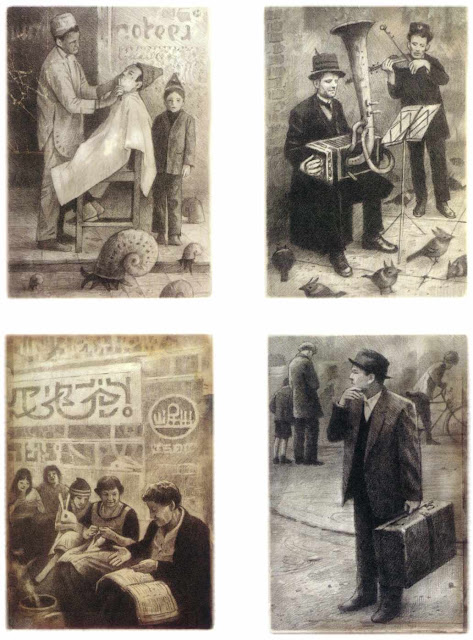
This may be an overly long introduction to a book that has no words. To cut to the chase, Shaun Tan's graphic novel may be the very best possible way to share the immigrant experience with the second and third generation. It tells the story of a father who leaves his country, his wife, and his daughter, to head overseas to find a better place for them all.

It is a very strange world that he finds. One of the first things we notice is that even the birds look different. In fact, the reader will notice that these birds don't look like any birds anyone has every seen. It only gets stranger in the pages that follow: the man encounters a mystifying immigration process, and documents that are written in a language that doesn't look like any that the reader will know. The buildings, the food, the transportation - there is a uniqueness to it all. This new country looks like no real country on earth. So what is going on here?

The first time I read this graphic novel I didn't understand what was going on and stopped reading about half way through. This time around a helpful niece alerted me to the fact that this was about the immigrant experience, so what the artist was doing, by making everything just slightly peculiar, was creating a world where the reader would feel the same sort of discomfort and confusion that a new immigrant would feel upon arrival. That little insight was a big help, and turned this from a mystifying, even frustrating story, to an absolutely brilliant one. I will admit to being a bit slow on the uptake here, as the title, The Arrival, should have given me the only clue I needed as to figuring out what the book was about. But in my defense, Shaun Tan's creation is utterly original so I have not ever read anything like it.


We follow the father as he sets out to find a job, finds an apartment, tries to get the coffee machine (if that's what it was) to work, and tries to figure out where to find food and what sort of food he likes. Along the way he meets several helpful people, including people who had immigrated years before, and were happy to help someone newly arrived.

So the book is, on the one hand, about the immigrant experience, and on the other is story about the impact we can have in helping strangers. The young father would have been lost but for the kindness of strangers.

This is a large book, both in the number of pages, and in the size of the pages – 128 pages and about a foot tall – with scores of details to discover on every page. So even though it is wordless, this is a good long read. I would recommend this to immigrant grandparents as a gift they could give to the grandchildren, and one they might want to "read" with them. I would also recommend it to anyone who loves art - this is a beautiful book. Finally, I would also recommend it to students who are struggling readers. This is a book with dimension and depth, even though it doesn't have words. So it requires something of the reader - it can stretch them - even as it makes things a bit easier by doing away with dialogue.

It is also quite a good value, at just $12 for the hardcover edition at Amazon.com.

Saturday, June 14, 2014

Around the World in 80 Days

by Jules Verne

2005, Brilliance Audio or Penguin Random House
read by Jim Dale
7 hours and 51 minutes

When I first encountered a Jules Verne story as a kid, I was fascinated by it, mainly because I couldn't tell if it was truth or fiction - whether the accounts of attacks on ships at sea were from the newspaper or from Verne's own inventive mind. Verne is known for that realism, for the book that so confounded me - 20,000 Leagues Under the Sea - features descriptions of a submarine that influenced the later inventors of the real thing, including naming an early actual submarine after the submarine in the novel.

I was not so confused by Around the World in 80 Days, but I can imagine Verne sitting at his desk with a huge world map on the wall, multiple railway and shipping timetables, and numerous travel books. His intrepid 19th-century hero, Phileas Fogg, faces numerous obstacles that threaten to upset the connections between the many different forms of transportation he needs to complete his meticulously planned trip around the world.

Who is this Phileas Fogg? Not the dashing hero one might expect - though he is a proper English gentleman. Instead, he is a rich, eccentrically predictable man, so predictable that he fires his personal servant because he runs the bath two degrees hotter than usual. His new valet, Passepartout, is overjoyed to be working for such a blandly predictable man after a more madcap youth of his own, so when Fogg takes a wager at his gentleman's club that with the new methods of transportation, traveling around the world in 80 days is possible for anyone, and then has to prove it by undertaking the trip himself, Passepartout's reactions make the voyage both amusing and exciting.

One aspect of Verne's writing that is often forgotten is his capacity for lighthearted irony, when one or more of the characters (sometimes the narrator, as in Journey to the Center of the Earth) is not quite as adventurous as the others. There is plenty of genuine high adventure - deciding to rescue an Indian princess about to be burned on a funeral pyre, coping with a detective who is sure that Fogg has robbed the Bank of England, seeking to cross the ocean on a boat that is slowly being burnt down to the waterline - but the tension between the suspense of Fogg's journey and the mix of incredulity and frustration on the part of Fogg's servant is particularly funny when the book is read aloud by an able reader, like Jim Dale (in the audiobook version).

What also helps makes this book one of Jules Verne's most adapted stories - with multiple movies and an epic miniseries - is the combination of romance and one of the most suspenseful endings in fiction, as Phileas Fogg arrives in England prepared to lose his fortune as he calculates that he has arrived a day late.

While this is in no sense a Christian book, Fogg is an admirably honorable man (though obviously involved in gambling) who is willing, when the chips are down, to jeopardize his wager for the safety of others - and Passepartout is both courageous and loyal to his new and unexpectedly mobile master.

One qualification on Verne himself - Journey to the Center of the Earth deals with a trip not only inward but supposedly also backward in time, as the protagonists see the characteristics of various geological ages. Though the story never mentions evolution, and puts creatures of various so-called epochs together, Verne does seem to be accepting the commonly accepted idea of long ages of time with various creatures appearing first in specific eras. Not much room for a young earth there. That said, except for a certain lack of clarity about Sunday activities, Around the World in 80 Days is not so problematic.

To get a free e-book version, go here.

Otherwise the audiobook version I listened to can be had at Amazon.com here, and Amazon.ca here. Various inexpensive paper versions are also available.

Saturday, June 7, 2014

More wordless wonders

My oldest daughter is 4 and while she loves books, she can't read yet. So it is quite a treat when we find a really good wordless book, which Dad can "read" through with her the first time, and which she can then read through on her own, or to her little sister many times afterwards.

More and more of these "wordless wonders" are being made, so I thought I would share a couple of my favorites here. Be sure to also click on the "wordless" in the tag cloud in the righthand column of this page to find others.

The Hero of Little Street
by Gregory Rogers
32 pages / 2012 / Hardcover

This one is a favorite for me because it has a Dutch flavor (and so do I). The story begins with our hero – a little boy with a Charlie Brownesque look about him – managing to lose a trio of bullies by popping into a museum. Since he's there, the boy decides to take a look. And after he contemplates some modern art pictures and sculptures he comes across a room full of masterpieces, including Jan van Eyck's Portrait of Giovanni Arnolfini and his Wife. While passing by the piece our hero catches the eye of the Giovanni's little dog, and down he comes, right out of the painting! 

Jan Van Eyck's original (left) and a couple frames from Gregory Rogers (right) showing his version
The two of them then dance and jump and chase one another through the museum, until they come across a sheet of music lying on the ground. Where did it come from? Ah, wait! The two of them notice that it must have been dropped by that lady at the piano - that lady in Jan Vermeer's painting Girl at Piano. So in they jump, right into the picture, and return the music to the grateful girl.

This leads to some more dancing, accompanied by the girl at her piano, before our hero and his dog head off further and deeper into this painting, opening a door and entering Little Street, Deflt in seventeenth century Holland!

To say this is an inventive book really doesn't suffice! An art loving parent could use this to introduce their children to some of the masters, and anyone of a Dutch heritage could use it to show what the Netherlands looked like back three centuries ago. And young children love it for the sheer rollicking adventure. It ends with our hero back in modern day, but now equipped by his time-traveling artistic adventure with just the tool he needs to help him with those bullies.

You can buy it Amazon.com here (clicking here will also help support this site, as Amazon will send us a small percentage, at no cost to you).

The Boy and the Airplane
by Mark Pett
40 pages / 2103 / Hardcover

This is a simple enough story - a boy gets a toy airplane as a present and an errant throw results in the plane getting stuck on the top of a roof. We then get to see him try everything from a ladder (too short) to a lasso, to a pogo stick, to try and recover his plane. But when nothing works the boy settles on a long term strategy that, while it will require patience, is sure of success: he plants a seed and waits for it to grow into a mighty tree that will be tall enough for him to climb and recover his plane.

I am not going to spoil it here by telling you the end, but it is sweet, and completely satisfying. This was just a joy to read with my little girl!

I will note it is a pretty quick read, so it might be a good one to borrow from the library, rather than buy... but if you do want to buy it, you can find it at 

Amazon.com here
. The author has also made a worthy sequel, titled The Girl and the Bicycle.