Saturday, February 7, 2015

Dragons: Legends & Lore of Dinosaurs

edited by Bodie Hodge and Laura Welch
2011 / 24 pages

This book is often paired with Dire Dragons by Vance Nelson, and there's a good reason for that. Both books argue that, contrary to what the evolutionists say, dinosaurs (aka dragons) and people lived at the same time. But while Dire Dragons makes its case by sharing all sorts of physical artifacts of dragons from around the world – sculptures, drawings, etchings, reliefs, paintings, pendants, etc. – the editors of Dragons: Legends & Lore of Dinosaurs make their case by sharing the many stories of dragons from around the world. If no human has seen a live dinosaur, then why do the descriptions of dragons in these stories bear such a striking resemblance to dinosaurs?

It's a good question, and the make their case with stories from Greece, China, Britain, and even America and South America. And while most every story is sourced, sometimes the source is a website, which isn't, in my mind, the most credible of sources. That bugged me a bit, because this is the sort of book that is going to attract heated opposition because what it is saying is so very counter-cultural. So when you know the heat is coming, why not go to the extra effort and make sure all your sources are rock solid? But that said, this is intended as a children's book, so maybe I shouldn't criticize it for not having textbook type sourcing.

It's short, just 24 pages long, but these are no ordinary pages: one has a half dozen envelopes to open with messages within (see pic), others have flaps to unfold, and on a couple there are even mini books to read. So there is a lot to explore, and this is a very fun of exploring it - there are lots and lots of fantastic dragon pictures to see. I’d recommend this for Grade 2 and up (and Dire Dragon for an older audience, maybe 10 or even 12 and up).

 The one downside is that target audience for this group 12 and up boys, is also a group that would very likely lose or rip bits of it. So if parents make a gift of it, they either need to give it to very careful kids, or be fine with it getting tattered over time.

You can buy a copy at Amazon.com by clicking here.

Wednesday, January 28, 2015

Bell Mountain

by Lee Duigon
267 pages / 2010

Jack and Ellayne are on a mission from God: they are going to ring the bell that King Ozais built on the top of Bell Mountain. But there are a few things in the way:
  1. They’re just kids who don’t know anything about mountain climbing, traveling through the woods or living off the land.
  2. They’re not sure there really is a bell on the top of Bell Mountain – no one alive has ever seen the bell.
  3. A talented assassin has been sent to stop them.
  4. They think the end of the world might happen when they ring it.
It’s quite the mission, and quite the opening for this, the first book in author Lee Duigon six-going-on-seven book series, (with plans for at least eight). The setting seems to be a Medieval one: travel is conducted by horse and oxen, people live in walled cities and villages, and they fight with swords and spears. But when Jack and Ellayne meet a little squirrel-sized chirping man-creature named Wyyt it becomes clear this is not our world. Here Man once had the power to fly through the skies, but no longer – something happened long ago that left behind destroyed cities, and set technology back a thousand years. In this post-apocalyptic world the national “church, or Temple has become so corrupt that no one reads the “Old Books” anymore but instead only the Temple’s interpretation of the Old Books is shared (if this makes you think of the pre-Reformation Roman Catholic Church, I’d agree that the author’s Reformed bonafides are showing). As the author puts it, people have forgotten how to listen to God. They don’t even know how to pray – that’s something the priests do for them. Now God is going to use two little children to rectify the situation.

This is definitely a children’s story. The heroes are children, the tension level is appropriate for ten and up – lots of peril but nothing nightmare inducing – and the plot, while nicely layered is simple enough for children to follow. But, like the Narnia series, there is a depth behind the books that will make them enjoyable for adults as well. And Lee Duigon is simply good at what he does. I knew from the get go this was a quest story, but I was always eager to find out what was going to happen next. I quickly worked my way through all six, and I know I will enjoy reading them again with my daughters in a few years. 

The only way to purchase this series in Canada seems to be via the Chalcedon Foundation website store (chalcedon.edu/store). The Chalcedon Foundation is Reformed, as is our readership, but they are also Christian Reconstructionists, which most in our readership are not. It might be worth noting, then, that anyone who objects to Christian Reconstructionism would not find that a reason to object to anything in these books – it doesn’t come up.

Wednesday, January 21, 2015

Guide to Dinosaurs

by the Institute for Creation Research
2014 / 118 pages

I've reviewed 5 dinosaur books, all of them from a creationist perspective, and all of them fantastic. They have their particular strengths, and this would be the best of the bunch for anyone who wanted to learn it all.

This is the biggest book of the bunch, with the broadest breadth of topics it covers, as well as the greatest degree of depth on specific dinosaur kinds. This is still a layman's book - a beginner's text - but there is an awful lot to explore here.

Some of the topics covered include:
  • The history of dinosaur discovery (including who the first dinosaur fossil hunters were, their rivalries, and the first dinosaurs they discovered)
  • Dinosaur soft tissue finds
  • How dinosaurs are dated
  • The bird to dinosaur evolutionary theory
  • Tips on how best to approach a visit to a dinosaur exhibit in a secular museum
  • Dinosaurs in the Bible
  • How dinosaurs could have fit on the Ark
  • A sample inside page
  • Near-modern encounters with dragons (ie. Dinosaurs).

The last half of the book is devoted to two pages spreads on particular dinosaurs or dinosaur suborders. We’re told how big each kind is, how they were discovered, any controversies or creationist insights that might be specific to them.

So if an adult or teen was fascinated by dinosaurs and was going to pick just one book they probably get this one: its large pages offer and treasure chest of information. It is a very good guide produced by the trusted guides at the Institute for Creation Research.

You can get your copy at Amazon.com.

Wednesday, January 14, 2015

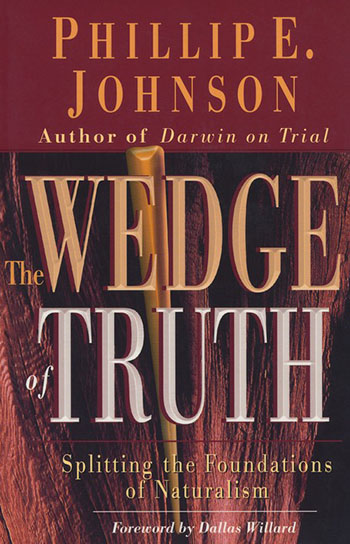
The Wedge of Truth: Splitting the Foundations of Naturalism

by Phillip E. Johnson
192 pages / 2000

Phillip Johnson taps into his expertise as a former Supreme Court law clerk and law professor to take Darwinism before the court of logic and consistency. His book unmasks the frequent claim that Darwinism and related evolutionary philosophies are the neutral approaches to finding scientific truth, and shows instead that secular scientists are philosophically committed to naturalism - the exclusion of the possibility of any intelligence being the cause of the origin of life.

He starts his discussion of the non-neutrality of today's science by going a little further back to tell the true story of how "Philip Wentworth Goes to Harvard" and loses his faith; at least that is how secularists portray the effect of the supposedly rational search for truth in university. Wentworth's own biography shows, however, just how well primed he was to leave his faith behind before he ever got to higher education - a reality paralleled today by the students whose nominal Christian upbringing and secular education in public school means that neither they nor their parents ever really gave Christian faith a chance.

Johnson continues his argument by asking whether "...Natural Law & Chance [can] Create Genetic Information." Of course, the answer is that that has never been observed, so Darwinists use less logical methods to defend their theory, leading to Johnson's next question - "Can Science Be Defended by Authoritarian Methods" as was attempted by legal maneuvers in Kansas? Next Johnson asks, "Does Theology Provide Any Knowledge?" - a skeptical question posed not by scientists but by secular philosophers, who should know better, since skepticism about the possibility of knowledge is itself a claim of knowledge. A similar question - "Is the Thinking, Choosing Self an Illusion?" - often posed by Darwinists also undercuts scientific research itself, something made clear by C. S. Lewis as well.

Then Johnson dispenses with attacks on scientific naturalism - the assertion that scientifically observable reality is all there is - to start making the case that the universe shows the signs of intelligent design. He links the intelligent design behind creation with Christianity with his question "What If We Start with the WORD?" He ends by noting that the twentieth century has been a time of "Technological Optimism & Literary Despair" because naturalism can improve our lives in many practical ways, but it cuts us off from meaning in our increasingly wealthy and comfortable Western culture.

While there is plenty of room for discussion of how we should unite reason and faith (as in the debate between evidentialist and presuppositional apologetics), Johnson's book reminds us that reason is not the enemy of faith, and that faith (Christian or secular) is always operating whenever reason looks - or claims to look - for truth.

If you want to read this examination of the religious nature of science - both secular and Christian - and the hope offered by Christian assumptions in science, go to this link at Amazon.com.

Thursday, January 1, 2015

Titus 2:1 Award

Ryan Smith, over at One Christian Dad has presented Really Good Reads with one of his annual Titus 2:1 Awards for doctrinally sound blogs. That's a fun way to start the year - thank-you Ryan.

And with this honor comes the responsibility of answering a few questions, and nominating another such blog. This blog is a team effort, with contributions from four Dykstras, but these answers will be from just one of us - Jon. And without further delay, to the questions:

A. If you could have dinner with any historical Christian figure, who would it be and why?
I could never use this as one of those questions they ask to help you retrieve forgotten passwords because I'd answer it differently every time. My answer for today is, Piet Jongeling, who is probably better known by his pen name, Piet Prins.

B. What 1 burning question would you ask?
I'd want to know how he did it all. This man was a giant: a journalist with a weekly column, a politician who was at times the leader of his party, and the author of 60 children's books including two series that are among my favorites: Scout, and Wambu (both of which will be reviewed here some time soon). And he was doing it all at the same time. He was faithful, insightful, and unbelievably prolific, so I'd want to know, from morning to evening, how he structured his day, his reading, and his writing.

C. Where and what would you eat?
It isn't fresh herring, but I'm thinking a good Dutchman would be able to appreciate sushi, particularly great quality sushi that is affordable, and made in a restaurant that closes on Sundays. So I'd bounce that off him, and if he was up for it I would take him to WasaBee in Bellingham.

D.  What was the last Bible verse you read?
The last verse was actually Titus 2:1, which reads, "You, however, must teach what is appropriate to sound doctrine." I've taken note of the winners of this award in the past, but never actually looked up the text. As a recipient I thought now would be a good time to check what it said.

As for the blog I'd nominate, some of the ones that spring to mind have already been nominated like Dr. Bredenhof's, or made mention of, like Tim Challies'. Another favorite hasn't been mentioned but would not be regarded as doctrinally sound by some, and I don't want to offer up a controversial nominee. So I'll go with one that is just as good, and who may be a tad controversial, but is much less so - I nominate Jay Adams.

Monday, December 29, 2014

A Pocket Guide to Dinosaurs

Is there a biblical explanation?
by Answers in Genesis
2010 / 94 pages

Over the last few years Answers in Genesis has released more than a dozen "Pocket Guides," most of which are on Creation-related topics with titles like: Global Flood, Six Days, Noah's Ark, Apemen, A Young Earth, and Charles Darwin. This is the third I've read, and I've really enjoyed all of them.

Dinosaurs clocks in at 94 pages (and small pages at that - this really can fit in your pocket) which gives it room to explore and address the big questions, but not in any sort of overwhelming detail. For me this was pretty much the perfect balance of information and conciseness – a good overview of the topic, which can be finished in an evening or two.

There are nine chapters, each written by a different author. The first, by Ken Ham, is the longest, covering nearly a third of a book, and giving an overview of how the different ways that evolutionists and creationists understand dinosaur fossils is really a clash of opposing worldviews - the same evidence is seen by both sides, but interpreted very differently based on their presuppositions (their starting assumptions).

This is a point made in each of these Pocket Guides, so if you read more than one, it will be a bit of repetition for you. But it is such an important point that hearing it again can only be a good thing. Additionally, each chapter is written by a different author which leads to some minor repetition, with points being made by multiple authors. Again, a little repetition (and that's all it is) is not a bad thing.

The other topics dealt with in the book include:
  • Did dinosaurs turn into birds?
  • Why don't we find dinosaur and human fossils together?
  • How did the dinosaurs fit on the Ark?
  • What killed off the dinosaurs?
  • Were there dinosaurs recently?
It is cheap enough, concise enough, and thorough enough that I'd recommend it as a fantastic give-away to anyone who believes the Bible and also evolution. There is probably not enough in here to turn an ardent evolutionist, but many who accept evolution do so on the sheer volume of evolutionary propaganda they've encountered, rather than for any specific reasons, and a book like this could be a real eye-opener for them. It is intended for adults, and would be accessible to older teens as well.

You can buy a copy here, at Amazon.com.

Oh, and for the dinosaur enthusiasts who wants to explore the topic in more depth, I would recommend the Institute for Creation Research's Guide To Dinosaurs.

Sunday, December 21, 2014

Dire Dragons

by Vance Nelson
2012 / 139 pages

This book is an argument, a response to evolutionary claim that dragons (ie. dinosaurs) died off millions of years ago, long before any humans roamed the earth. Or, as National Geographic put it, "No human being has ever seen a live dinosaur."

Vance Nelson says that just ain't so and he's marshalled the evidence to prove it. In page after page he shares artifacts from country after country. There are sculptures, drawings, etchings, reliefs, paintings, pendants and more, all of which were crafted hundreds of years ago, and yet clearly depict dinosaurs, sometimes with stunning accuracy. If no human has ever seen a dinosaur, then how did these artists get it so right?

Some examples:
  • a petroglyph in Utah dated at more than 800 years old shows a Sauropod 
  • A pre-Columbus pot from Peru which seems to show a Protoceratops
  • A brass etching in Britain from 500 years ago which shows to Sauropods intertwined (see pic below)
  • A turquoise dragon carving from China, dated to 4000 years ago which looks nearly identical to an adolescent Protoceratops
Nelson shares dozens and dozens more, some more impressive than others, but all of them contributing to a wealth of evidence showing man did indeed live at the same time as dinosaurs.

brass etching crafted over 500 years ago
I've read articles, and seen a documentary or two on similar subject matter before, so I was pleasantly surprised to learn that, as the author notes, "Most of the evidence presented in this book is 'new'" and hasn't been previously published elsewhere. Another thing I really appreciated was how Nelson was willing to share what the critics said about the evidence he's marshalled. For example, in the first example I listed above - the Utah Sauropod - at least one evolutionist thinks it's just depicting a squirrel. Hmmmm.... I don't think so. But I do appreciate hearing the other side.

From front to back this is a really slick book with beautiful ultra-realistic pictures of a host of different dinosaurs. I first read this with two of my pre-school daughters, and while this was a bit beyond them, these pictures held their attention. We flipped from page to page and my three-year-old kept offering her considered opinion that the dinosaur shown on each new spread was "pretty cool."

That said, the book's target audience is adults and maybe as young as Grade 10 (for younger kids, Grade 7 and up, Dragons: Legends & Lore of Dinosaurs makes a similar argument). It would be of the most interest to anyone who knows that evolutionists don't belief men and dinosaurs lived at the same time. You buy a copy at Amazon.com by by clicking here. .

Saturday, December 13, 2014

The Book That Made Your World: How the Bible Created the Soul of Western Civilization

by Vishal Mangalwadi
442 pages / 2011

A recent review on this blog demonstrated that religious pluralism does not reflect the real world, specifically that Islam does not function as a religion of peace wherever it is in control. Vishal Mangalwadi has a similar story to tell, one that actually reflects greater respect toward other civilizations than the ideas of today's politically correct.

What Mangalwadi shows is that the Bible was crucial in promoting the progress of Western civilization, even though in many ways Indian and Chinese cultures, for instance, were much more technically advanced than European societies. He starts by showing the emptiness of present Western culture - "the West Without Its Soul." Next he traces his own journey toward an understanding of the need for a Christian foundation for culture in his native India - to curb corruption and to guide the search for basic understanding of the universe and of himself.

Mangalwadi next demonstrates how the Bible led Western culture to a basic respect for humanity that made human life worthy of protection, to a love for logic connected to the real world (unlike Greek philosophy) that made science possible, and to a compassion that drove monks to invent labour-saving technology and spare humans the tedium of back-breaking toil. He explains how the incarnation of God in Christ led to a new understanding of the hero that has enriched our communal life, and how the command to spread the gospel to foreign cultures led to the creation of hundreds of written languages that promoted many countries' emancipation from colonialism.

Biblically based worldviews have not only had massive practical effects, but continue to affect such cultural activities as literature, education, and science. Mangalwadi also sketches how the influence of the Bible has positively influenced the morality of Western culture, the strength of the American family, the commitment of Western medical care, the stewardship of wealth in Western society, and the love for liberty in Western political life.

He concludes by affirming how necessary the Bible is to bring Stone Age tribes safely into contact with the wider world and to safeguard Western culture from becoming irrelevant. An appendix shows that the Bible does not need to be a "fax from heaven" to be the trustworthy and inspired (and powerful!) word of God - powerful not only to change individuals, but whole cultures.

If you want to read this wide-ranging look at God's power to transform the whole world through His word, go to this link at Amazon.com.

Sunday, December 7, 2014

North or Be Eaten

by Andrew Peterson
330 pages / 2009

The second book in the Wingfeather Saga is more serious and somber than the first, On the Edge of the Dark Sea of Darkness but author Andrew Peterson's whimsy is still in full evidence here, starting with the title, and continuing on throughout the book, as our heroes meet:
  • a hag with a schoolgirl crush
  • a villain who can be bought off with fruit
  • and the Florrid Sword, who, in the midst of battle, shows himself to be a remarkable swordsman and an even better wordsmith
I don't often review more than one book in a series like this because, well, who's going to start a series based on a recommendation of the second book? But I'm making an exception this time around because I wanted to be able to double down on my previous recommendation - this is another wonderful book in a simply a fantastic series!

There's lots to love here, but one of things I particularly appreciated is how Peterson talks about magic. There's always magic in Fantasy series, and that's the reason that some Christians have a problem with this genre – magic belongs to the supernatural, and the supernatural is God's domain, so hands off wizards, sorcerers and other enchanting sorts!

But Peterson ensures that the magic in this series remains firmly in God's domain. As the children's mother Nia explains to her son Janner:
What is magic anyway? If you asked a kitten, "how does a bumblebee fly?" the answer would probably be "Magic!" [The world] is full of wonders and some call it magic. This is a gift from the Maker - it isn't something that [your sister] Leeli created or meant to do, nor did you mean to see these images You didn't seek to bend the ways of the world to your will. You stumbled on this thing the way a kitten happens upon a flower where a bumblebee has lit.
So the magic in this series isn't a means by which a man can become god-like, but is instead, a wonder given by God to men. And that makes all the difference in the world!

This is listed as for Young Adults but kids as young as 12 could certainly enjoy it. And I would particularly recommend this for dads who read to their kids - then this might be good for as young as ten, and dad will enjoy it as much as they do. You can buy a copy at Amazon.com by clicking here.

Friday, November 28, 2014

Hatred: Islam’s war on Christianity

by Michael Coren
183 pages / 2014

A dozen years ago I wrote an article called “Don’t read a newspaper, read a book.” Today I might swap in “blog” for “newspaper” but my point would remain the same: journalists have deadlines to meet, and word counts to hit, and sometimes mere hours to do their research. So what they deliver is often one-sided, or shallow, or uncertain, or even wrong. If we want depth and research then we need to turn to someone who has taken the time to actually craft a book.

If you want know about how Islam interacts with Christianity around the world, then you need to pick up Michael Coren’s Hatred. Here, in black and white, is a recounting of consistent, constant persecution. Coren devotes individual chapters to different predominantly Muslim countries, including Egypt, Pakistan, Iran, Iraq, Indonesia, and then all of Africa, and finally everywhere else. In chapter after depressing chapter the outcomes are repetitive: wherever Muslims are in power, Christians face persecution, sometimes simply of the social and economic kind, but in many other occasions of the murderous sort.

Coren is a pretty level headed fellow, so it’s doubly valuable to have such a book from him. This is no nutbar, no crazy conservative telling us that:
A victim and a perpetrator cannot meet in some imaginary middle, a person who is being beaten cannot compromise with the person doing the beating. Christian forgiveness is vital in all this but the new equation has to begin with the cessation by Muslims throughout the world of their hateful campaign against innocent Christians.
The repetitious recounting of murder after murder makes this book depressing, but it also makes an irrefutable case that Islam is not a religion of peace (yes, some Muslims are peaceful – many Muslims are peaceful – but the murderous sort are no small fringe minority). If you know anyone who thinks differently you should get them this book. You can buy a copy at Amazon.com by clicking here.

Friday, November 21, 2014

John Knox

by Simonetta Carr
60 pages / 2014

Like her seven other children’s Church history books, Simonetta Carr’s John Knox is a gorgeous production. The full-color picture book includes 42 illustrations in its 60 pages, including a dozen full-page paintings created just for this volume. And the hardcover and quality binding mean this is strong enough to bear up to children’s use and still be passed on to the next generation.

John Knox, sometimes known as the Scottish John Calvin, is a fascinating subject starting his Reformed journey as a bodyguard, then getting sent to the galleys to row as a slave, and finally becoming a minister to a king and a thorn in the side to queens.

Carr does a solid job of telling Knox’s story, but this is more history book than storybook, a great educational resource, but not necessarily a book that a child would want to read on their own. So I wouldn’t recommend this as a present from the grandparents…unless they intend to read it to their obliging grandchildren. But for anyone intent on teaching Church history, whether Mom or Dad, or in a school setting, this would be a great purchase. I would recommend this for Grades 2 to 6.

One bit that struck me as humorous was that Carr chose to refer to Knox’s most famous work – or, rather, most infamous – by the first part of its title, rather than its full title. In this book Knox argued that women should not rule countries, and Carr refers to it as The First Blast of the Trumpet, but the full, and very politically incorrect, title is: The First Blast of the Trumpet Against the Monstrous Regiment of Women.

But that is a little aside. This is a gorgeous book, and if it doesn't quite make learning Church history entertaining, it certainly will make it pain-free. You can purchase it at Amazon.com by clicking here and at Amazon.ca here.

Friday, November 14, 2014

The Door in the Wall

by Marguerite de Angeli
128 pages / originally published 1949 (latest edition 1998)

This classic children's book should be in every household. It is a simple story of a boy who, like all (or at least most) children, worries that he cannot measure up to the hopes of his parents.

Of course, as in any story, this universal theme of growing up only catches at the heart when it is couched in a particular setting. The setting in this story is the Middle Ages. The anxiety of the boy mentioned above (whose name is Robin) arises not from wandering through the modern adolescent angst of a typical "Teenage Wasteland," but from being lamed by a mysterious illness that the medicine of the Middle Ages could neither understand nor cure. Robin's parents are not your typical upper-middle-class professionals of our day, looking for the right college for their boy; instead, they each serve the King and Queen, and are absent when Robin lives through the deadly sweep of the plague through London. Robin's journey back to his parents' estate, hobbling on crutches the entire way, and facing the dangers of the medieval countryside, becomes a symbol for his quest to figure out his purpose and place if he cannot ride into battle as his father does. With the help of education from Brother Luke and Brother Matthew, and in hope in God, Robin searches for "the door in the wall" - the opening in his circumstances that will allow him a way forward. The story climaxes with the revelation of a literal door in the wall that reunites Robin with his parents, and allows him too to serve his king in his own way.

A great story to encourage children to look beyond their limitations toward the possibilities that God puts in their paths through the help of other Christians, with (as a big bonus) thoughtful and compelling illustrations by the author herself. You can find it at Amazon.com here.